

Abraham Quiros Villalba AI tool: What Is Actually Verified?
Search for theAbraham Quiros Villalba AI tool, and you will find confident descriptions of a platform that analyses markets, cryptocurrency, sentiment, and early-stage companies. The central problem is that most of those descriptions repeat reported or self-published claims rather than document a product that an ordinary user can inspect, test, or buy.
Quick answer: A personal website associated with Abraham Quiros Villalba says an AI-powered investment platform is in beta and accepts early-access requests. As of September 2026, I could not verify a public application, pricing page, technical documentation, independent performance audit, or credible hands-on test. The fairest description is therefore an unverified beta-stage project or concept, not an established public trading tool.
This distinction matters because “a platform is being developed” is not the same as “a working product has been independently evaluated.” This guide separates the published claims from the available evidence and shows you how to investigate the project safely if access becomes available.
Financial disclaimer: This article is general educational information, not investment advice. Never send money, connect a wallet, or trade based only on a website, an online article, or an automated prediction.
Key Takeaways
- A self-described personal website presents the project as an AI-powered platform for investment research and says beta testing is underway.
- Public descriptions commonly associate it with historical market data, real-time prices, sentiment analysis, crypto research, and startup monitoring.
- Those proposed capabilities have not been confirmed through public documentation, a testable product, an independent audit, or reproducible performance results.
- No credible tool can guarantee profitable trades. Market predictions remain uncertain even when machine learning is involved.
- The safest approach is to wait for verifiable product access, company details, policies, data-source disclosures, and independently tested results.
What Is the Abraham Quiros Villalba AI Tool?
The most direct source is Abraham Quiros Villalba’s personal website. It describes an AI-powered platform being built to examine historical trading data, live prices, public sentiment, and startup activity. The site also says the project is in beta and is aimed at longer-term investment research rather than high-frequency trading.
Those statements tell us how the project is positioned, but they do not independently prove that every feature works as described. A founder or promoter is a primary source for what a project claims about itself, not independent evidence of its accuracy, reliability, or commercial readiness.
Several third-party articles go further and call it a market-prediction system, crypto research assistant, content tool, or trading platform. The inconsistency is itself a warning to slow down: a clearly launched product normally has one official name, a stable feature list, documentation, access instructions, support information, and terms of service.
Confirmed facts, reported claims, and missing evidence for the investment AI project
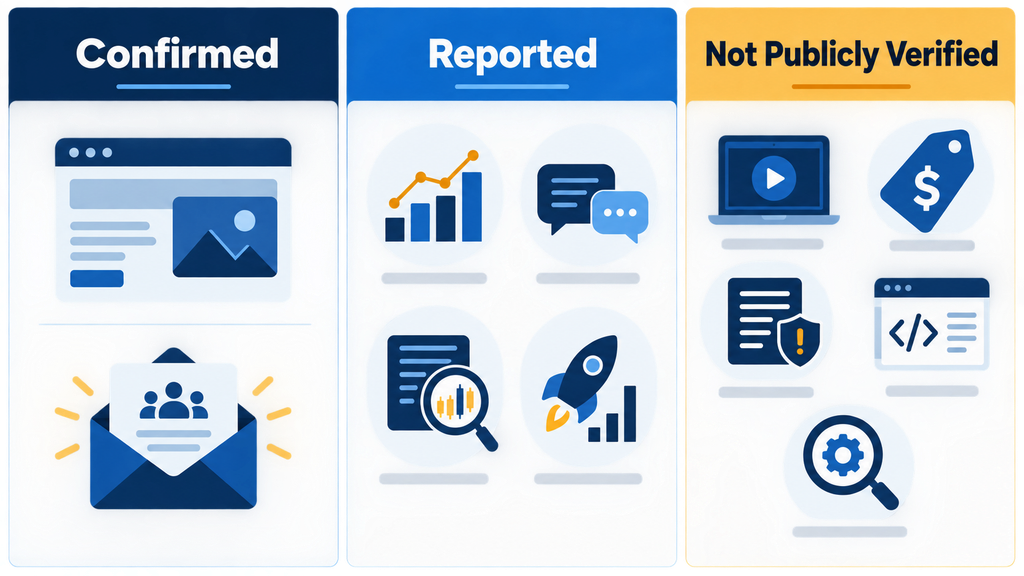
Claimed Features Versus Available Evidence
The following table avoids treating a proposed feature as a proven capability. “Reported” means the feature appears in the project’s own description or in articles discussing it; it does not mean TechMezz independently tested it.
| Reported capability | What it would do in theory | Public evidence found |
|---|---|---|
| Historical pattern analysis | Compare past prices, sectors, and market events | Described, but no model card, methodology, or benchmark published |
| Real-time market feeds | Monitor current stock, crypto, or commodity prices | Described, but no data providers, update intervals, or live interface disclosed |
| Sentiment analysis | Analyze media, forums, and commentary for market mood | Described, but no source list, sampling method, or accuracy test published |
| Crypto prediction | Estimate possible price or volatility movements | Claimed conceptually, but no independently audited track record found |
| Startup monitoring | Surface early-stage or pre-IPO opportunities | Described, but no coverage universe, scoring model, or test results disclosed |
| Risk guidance | Help users interpret signals for longer-term decisions | General positioning only; no suitability process or regulated-advice status verified |
The architecture is plausible in a general sense. Many financial research systems combine quantitative information with text analysis, but plausibility does not establish that a particular product exists, uses good data, avoids leakage, or performs better than a simple benchmark.
A polished explanation can also hide difficult questions. For example, a sentiment model must decide which sources to monitor, how to detect bots and coordinated promotion, how quickly to update, and how to prevent old information from contaminating a backtest. Without documentation, you cannot judge those choices.
Is the Abraham Quiros Villalba AI Tool Legit?
There is not enough public evidence to give a confident yes-or-no answer. The available material supports the narrower conclusion that a website describes a beta project, while essential details needed to evaluate an investment product remain unavailable.
“Unverified” does not automatically mean fake or fraudulent. It means the evidence is insufficient for a responsible reviewer to confirm the product’s identity, functionality, performance, security, or availability. That is a reason to pause, not a reason to make an accusation.
What I Could Verify
- A public personal website uses the Abraham Quiros Villalba name and contains a section describing an investment-focused AI platform.
- The site characterises the platform as being in beta and includes an early-access invitation.
- The published description refers to historical data, current price feeds, sentiment, and startup ecosystem signals.
- The site says the platform is intended for strategic, longer-term research rather than rapid automated trading.
What I Could Not Independently Verify
- A public login, working dashboard, downloadable application, or accessible trial
- A legal company identity clearly tied to the product
- Public pricing, subscription terms, cancellation rules, or support commitments
- Technical documentation, API references, a model card, or a public code repository
- Named market-data providers or proof that the platform is licensed to redistribute data
- Independently audited returns, prediction accuracy, backtests, or live results
- Detailed privacy, cybersecurity, custody, or wallet-connection practices for the product
- Regulatory registration for any activity that would require it
Checklist for verifying an AI-powered investment research platform
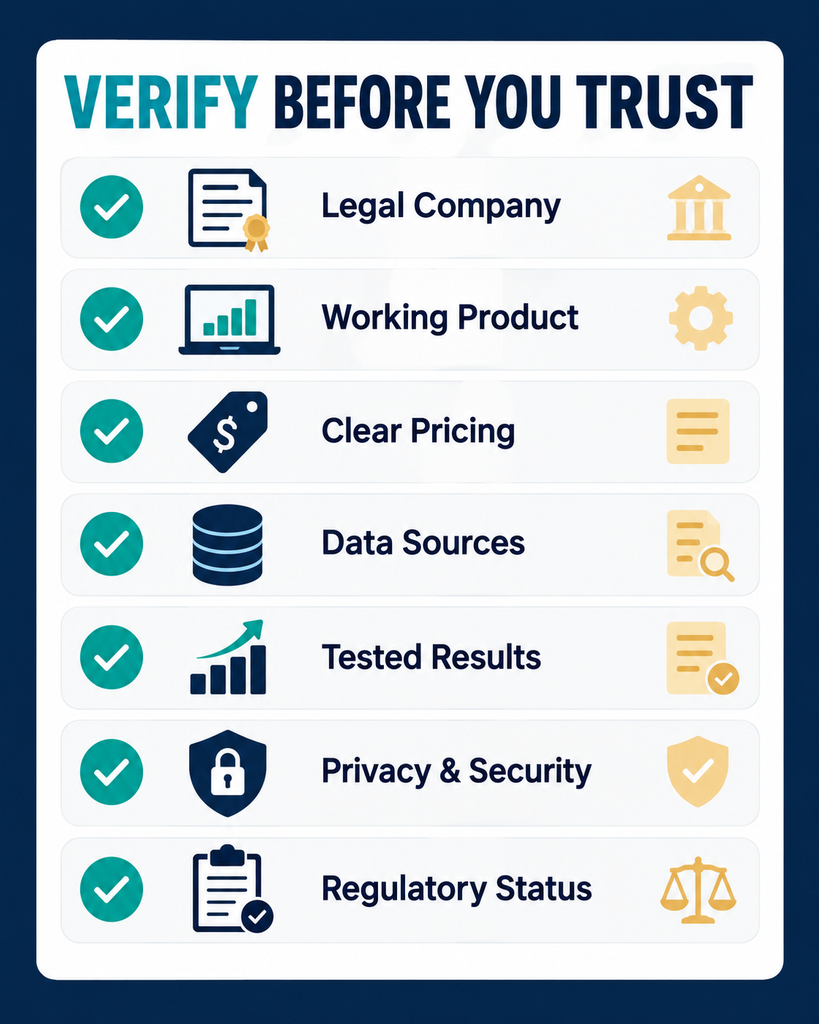
Why Search Results Give Conflicting Answers
The pages ranking for this term do not describe the same product consistently. Some frame it as an investment research assistant, one discusses content planning and writing, and others describe market predictions or a beta platform as if those capabilities had already been tested. This pattern suggests that summaries are being repeated without enough primary evidence.
Search visibility is not product verification. A claim can appear on several websites because later publishers copied or paraphrased earlier descriptions, not because each publisher obtained access and performed a separate review. Before trusting any AI product review, look for screenshots from a real account, a named test method, dates, input examples, measured outputs, limitations, and disclosure of whether the reviewer actually used the tool.
TechMezz’s Ineedthis AI review provides useful context for evaluating a named AI service through identifiable features and access information. Its guide to how AI uses water also shows why technology claims should be traced to the infrastructure and evidence behind them rather than accepted from a headline.
How to Vet the Tool Before Using It
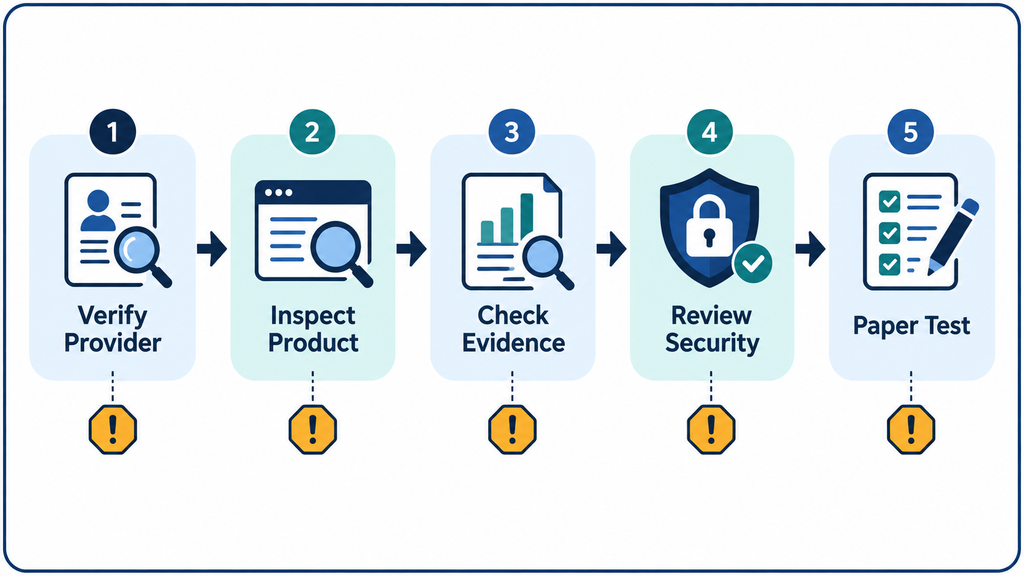
I recommend treating verification as a sequence. Do not skip to performance claims before you know who operates the product, what you are agreeing to, and how your information or money would be handled.
1. Confirm the Provider’s Identity
Look for a registered business name, physical jurisdiction, leadership names, support channel, and legal documents that all refer to the same entity. A personal biography and a contact form are not substitutes for clear product ownership and contractual information.
If the service offers personalised securities recommendations or introduces you to an adviser, check the individual or firm through BrokerCheck and the Investment Adviser Public Disclosure database. A missing listing does not prove misconduct because not every software provider must register, but the provider should explain its role accurately and avoid implying regulatory approval it does not have.
2. Demand a Real Product Trail
A verifiable tool should have a consistent product name, official access route, current documentation, release notes, support information, and terms that explain availability. If it is invitation-only, ask for a written description of what testers receive and whether funds, brokerage credentials, or wallet access are required.
One detail I would not overlook is domain consistency. Emails, payment pages, documentation, and sign-in screens should use official domains, not lookalike addresses, shortened links, messaging-app accounts, or unrelated payment processors.
3. Examine Performance Evidence
A screenshot showing profitable trades proves very little. Useful evidence explains the test period, assets covered, transaction costs, comparison benchmark, failed signals, maximum drawdown, and whether results came from a live account or a backtest.
Backtests can look impressive when developers select favourable periods, tune a model on future information, or omit fees and slippage. Ask whether the results were evaluated out of sample and whether an independent party reproduced them. The CFTC’s warning about AI trading bots makes the core point clear: AI cannot turn a trading system into a guaranteed money machine.
4. Review Data and Model Transparency
The provider should identify the categories of data it uses, the approximate update frequency, major limitations, and how it handles missing or manipulated information. It should also explain whether output is a forecast, a ranking, a summary, or personalised advice, because those are not interchangeable.
The NIST AI Risk Management Framework offers a useful standard for thinking about validity, reliability, transparency, privacy, security, and ongoing monitoring. A small provider may not implement every formal process, but it should still be able to answer basic questions in these areas.
5. Protect Your Money and Personal Data
Start with public or non-sensitive information. Do not upload identity documents, tax records, brokerage statements, private company files, seed phrases, or API keys until the provider’s legal identity, privacy terms, security controls, and actual need for the data are clear.
Never share a wallet recovery phrase. If a product eventually supports exchange or brokerage connections, use read-only permissions first where possible, enable multifactor authentication, and restrict any API key so it cannot withdraw funds.
Five-step process for safely evaluating an unfamiliar financial AI tool
Red Flags That Should Stop You
Regulators have warned that promoters may use AI language to make an investment offer sound more advanced or trustworthy than it is. The joint investor alert about AI and investment fraud recommends checking the background of anyone offering an investment and being sceptical of claims that rely on AI hype.
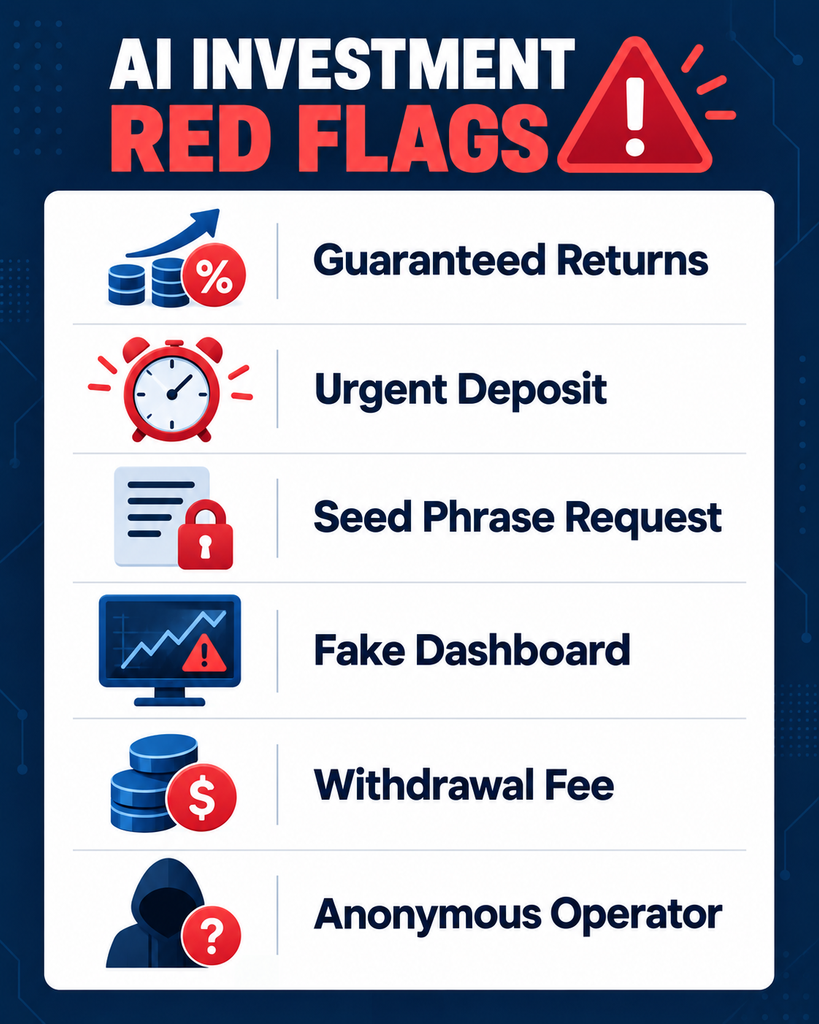
Stop and investigate further if you encounter any of these signs:
- Guaranteed profits, a fixed win rate, or claims of risk-free trading
- Pressure to deposit immediately or “activate” an account with crypto
- Requests for a seed phrase, remote-computer access, or unrestricted exchange keys
- A dashboard showing gains while withdrawals are delayed or require new fees
- Testimonials without verifiable identities, dates, or methods
- No clear company, terms, privacy policy, refund policy, or accountable support team
- A celebrity endorsement or social profile that cannot be confirmed through the person’s official channel
- Performance claims that omit losses, fees, benchmarks, and testing periods
The FTC’s cryptocurrency scam guidance notes that promises of guaranteed profits or large returns are hallmarks of fraud. That rule applies no matter how often a promotion mentions algorithms, machine learning, exclusive signals, or a “beta opportunity.”
Red flags to watch for in AI investment and crypto platforms
How to Test It If Public Access Appears
If a legitimate public version launches, begin with a paper portfolio rather than real money. Record every signal before the outcome is known, define a benchmark in advance, and track wins, losses, fees, missed opportunities, and drawdowns over a meaningful period.
- Save the exact product page, terms, privacy notice, and pricing on the day you join.
- Choose a small, fixed set of assets and a simple benchmark before collecting signals.
- Record each forecast, its timestamp, time horizon, confidence, and stated reason.
- Include realistic trading fees, spreads, slippage, and taxes when comparing outcomes.
- Check whether the tool changes or deletes past calls after the market moves.
- Compare results with a basic passive strategy and with random or naive forecasts.
- Stop the test if the provider pressures you to deposit, hides losing outputs, or blocks data export.
A tool can be useful without predicting prices perfectly. It might save research time, organize sources, or help users apply a consistent checklist. Those benefits should still be demonstrated through accessible functions rather than assumed from promotional language.
Paper-trading worksheet for testing AI market predictions against a benchmark

Pros and Limitations of the Concept
Even though this particular implementation is not publicly verifiable, the broader concept has reasonable uses and serious limitations. Keeping both sides visible prevents excitement about automation from replacing due diligence.
| Potential value if implemented well | Important limitation |
|---|---|
| Monitors more sources than one person can read | More data can amplify noise, manipulation, and bias |
| Organizes price, news, sentiment, and company signals | Correlation does not prove that a signal predicts returns |
| Applies the same screening criteria repeatedly | A consistent model can still be consistently wrong |
| Speeds up research and creates shortlists | Speed can encourage overconfidence and excessive trading |
| Highlights unusual changes for human review | Market regimes change, making historical patterns unreliable |
I would judge the product first as a research workflow, not as an oracle. If it cannot show where a claim came from, explain uncertainty, preserve a history of past outputs, and let users question its conclusions, faster predictions may create more risk rather than more insight.
Frequently Asked Questions
Is the Abraham Quiros Villalba AI tool available to the public?
I found a personal website that describes the project as being in beta and invites early-access requests. I did not find a public application, trial, standard onboarding process, or confirmed pricing page, so ordinary public availability could not be verified.
Is it a crypto trading bot?
The project’s own description presents it more broadly as a research and prediction platform covering crypto, stocks, commodities, sentiment, and startup activity. It also says it is not intended for high-frequency trading, but no public product documentation was available to confirm how orders, alerts, or recommendations would work.
Can it guarantee profitable investments?
No legitimate market-analysis system can guarantee profits. Prices respond to unpredictable events, changing behavior, liquidity, fees, and model errors, so any promise of certain returns should be treated as a major warning sign.
Who is Abraham Quiros Villalba?
An associated personal site presents him as an investor and entrepreneur involved in energy, cryptocurrency, and technology. Many biographical claims circulate across promotional-style profiles, but readers should distinguish self-published information from records independently confirmed by reputable institutions.
Is it safe to request early access?
Submitting only a basic email address carries less risk than funding an account or sharing financial credentials, but you should still read the privacy terms and confirm the domain. Do not send money, identity documents, wallet recovery phrases, brokerage passwords, or unrestricted API keys merely to join a beta.
Conclusion: Treat the Project as Unverified for Now
TheAbraham Quiros Villalba AI tool is best understood as a publicly described, beta-stage investment AI project whose advertised ideas are plausible but whose implementation and results have not been independently established. The absence of public pricing, documentation, audited performance, and hands-on access means there is not enough evidence for a conventional product review or a confident legitimacy verdict.
If the platform launches publicly, evaluate the provider, policies, data sources, security, and results before risking money. For more evidence-focused technology explainers and tool reviews, explore TechMezz and use the checklist above whenever a new product makes ambitious claims.